

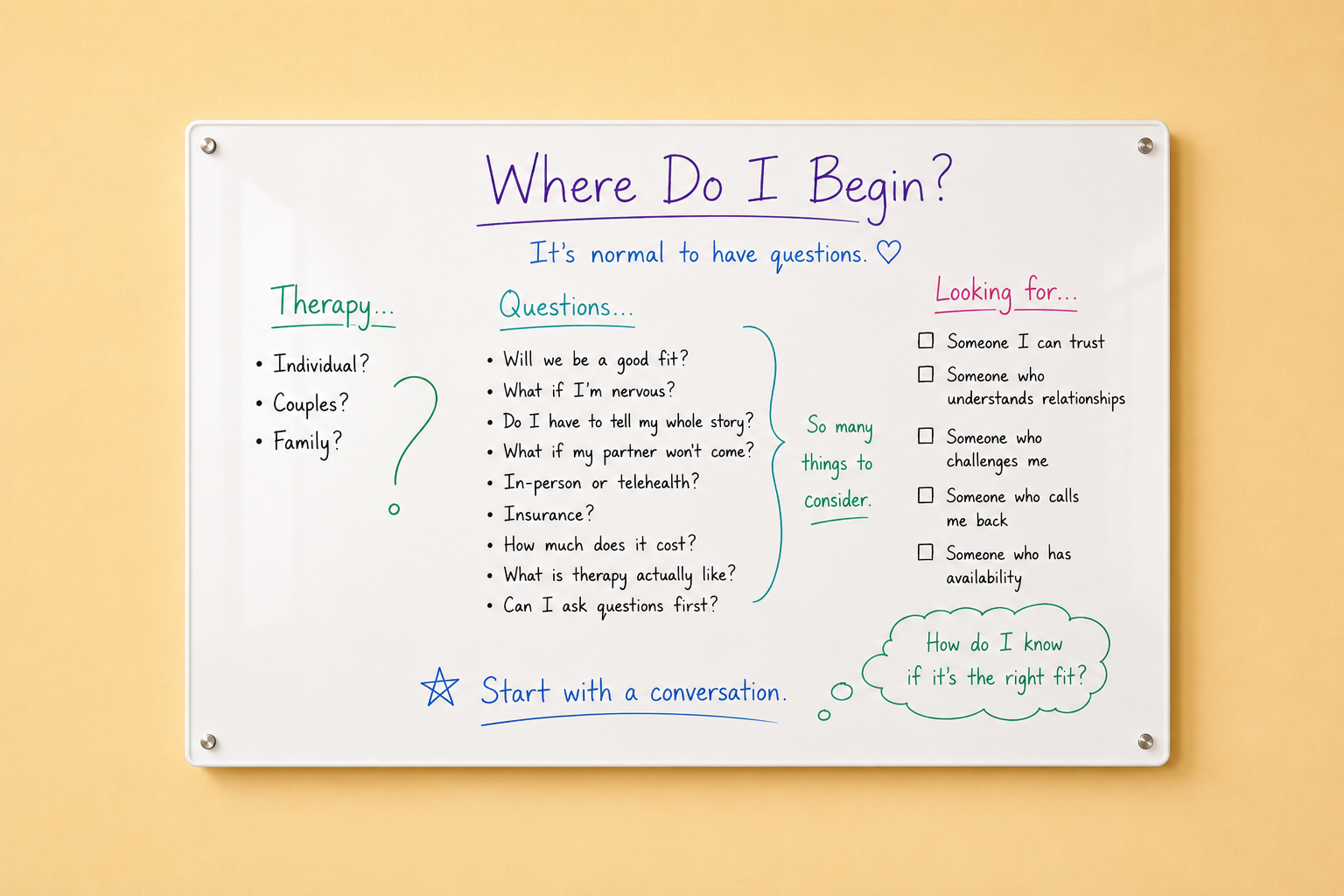

Where do I begin?
Questions you may have.
What is your approach to therapy?
I help people make sense of the patterns, relationships, and experiences shaping their lives so they can move forward with greater clarity, confidence, and direction.
My approach is relational, attachment theory, systems-oriented, strategic, and solution-focused. Whether I'm working with an individual, couple, or family, we'll look beyond the immediate concern to better understand the patterns contributing to feeling stuck. From there, we'll develop practical strategies that support meaningful and lasting change.
Clients often describe me as direct, thoughtful, empathetic, and easy to talk to. Therapy with me is collaborative, active, and focused on helping people move forward.
Do you work with individuals even though you are a Marriage and Family Therapist?
Absolutely.
Marriage and Family Therapists are trained to work with individuals, couples, and families. One of the benefits of working with an LMFT individually is that therapy explores not only what's happening within you, but also how your relationships, family experiences, attachment, and the larger systems around you may be influencing your life.
What issues do you commonly work with?
Some of the concerns I commonly help people navigate include:
Anxiety and depression
Relationship conflict and communication
Couples and marriage concerns
Family conflict
Divorce recovery
Co-parenting and parallel parenting
High-conflict relationships
Blended families
Estrangement and family disconnection
Life transitions
Stress and emotional overwhelm
Boundaries and relationship patterns
If you're unsure whether your situation is a good fit, I'm happy to discuss it during a free consultation.
What is therapy with you actually like?
I'll listen carefully, ask thoughtful questions, help you understand patterns that may be difficult to see, and challenge you when it helps move the work forward. My goal isn't to tell you what to do—it's to help you better understand yourself, your relationships, and the choices available to you.
I also sometimes use a whiteboard and visual mapping to organize communication patterns, relationship dynamics, family structures, and other systems. Many clients tell me that seeing these patterns visually helps everything make more sense.
Does everyone have to come to therapy?
No.
I work on the relationship that is in the room.
Sometimes that means working with one person. Other times it's a couple, a parent and child, siblings, or an entire family. Not everyone has to participate in order for meaningful work to happen.
When I'm working with couples or families, I often incorporate breakout sessions as part of the therapeutic process. These individual conversations can provide additional perspective while continuing to support the larger relationship and family system.
I often tell clients that each person in the room is important, and the relationship itself is also a client. My role is to understand both the individuals and the relationship they create together.
Do you offer both in-person and telehealth appointments?
Yes. I offer both in-person and telehealth appointments for clients located in Colorado.
Telehealth sessions are conducted through a secure, encrypted platform to help protect your privacy and confidentiality.
Do you accept insurance and what are your rates?
I currently accept insurance for individual therapy only.
Couples therapy, family therapy, and other conjoint services are private pay.
Because insurance participation, fees, and practice policies can change over time, I prefer discussing current rates and payment options during a free consultation.
How long are sessions?
Most sessions are 55–60 minutes.
Toward the last part of each session, I intentionally slow us down so we can organize what we've discussed, identify meaningful takeaways, and make sure you're leaving with something practical to build on between sessions.
I also offer optional 90-minute sessions when additional time would be beneficial. This can be especially helpful for some couples, families, or more complex situations.
The frequency of therapy depends on your goals and needs. Many people begin with weekly sessions, while others meet every other week or on a different schedule. We'll decide together what makes the most sense.
How do I know if we're a good fit?
Finding the right therapist matters.
That's one of the reasons I offer a free consultation. We'll briefly discuss what's bringing you to therapy, answer any questions you have, talk about scheduling, fees, and logistics, and determine whether my approach feels like a good fit for you.
If it doesn't, I'm always happy to help point you in another direction whenever I can.
Do you provide court evaluations or custody recommendations?
No.
My role is therapeutic rather than forensic. I do not provide custody evaluations, forensic evaluations, court recommendations, or legal advocacy services.
My focus is helping people understand relationship dynamics, improve communication, reduce harmful patterns, and build healthier ways of functioning within their relationships and family systems.
How do I get started?
Reach out to schedule a free 30 minute consultation.
It's an opportunity for us to talk briefly about what's bringing you in, answer your questions, discuss scheduling, fees, insurance, and determine whether my practice feels like the right fit for your needs.